

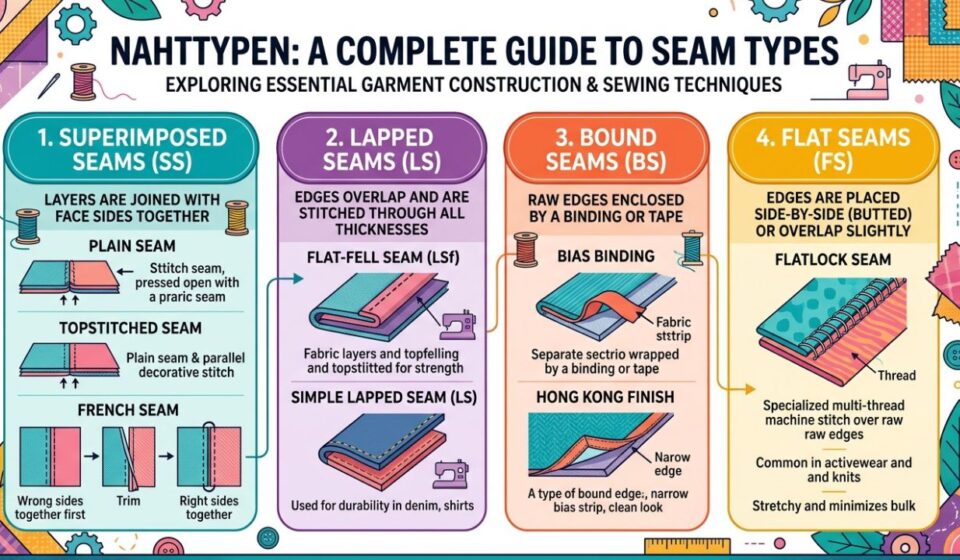

Nahttypen refer to the different types of seams used in sewing and garment construction to join pieces of fabric together. These seam types are essential in determining the strength, appearance, comfort, and durability of clothing. Whether used in fashion design, tailoring, or industrial textile production, Nahttypen play a central role in how garments are built and finished.
In simple terms, Nahttypen are not just stitching methods—they are engineering solutions for fabric. Each seam type serves a specific purpose, from preventing fabric fraying to improving elasticity or enhancing decorative appeal. Understanding Nahttypen helps beginners and professionals alike create better-quality garments with long-lasting performance.
Nahttypen Historical Development and Evolution
The development of Nahttypen can be traced back to early human history when clothing was first created using basic hand-stitching techniques. As civilizations advanced, sewing methods became more refined, and different Nahttypen were developed for specific fabrics and uses.
During the Industrial Revolution, sewing machines transformed garment production. This led to the standardization of Nahttypen in factories, allowing faster production and more consistent stitching quality. Over time, fashion designers and textile engineers began experimenting with more advanced seam structures, leading to the wide variety of Nahttypen used today.
Nahttypen Basic Seam Types in Sewing
Nahttypen can be categorized into several basic seam types that form the foundation of sewing. One of the most common is the plain seam, where two pieces of fabric are stitched together along a straight line. This is widely used in everyday clothing due to its simplicity and efficiency.
Another important type of Nahttypen is the zigzag seam, which is often used to prevent fabric edges from fraying. This seam is especially useful for stretchy fabrics and knitwear.
Edge-finishing seams are also part of basic Nahttypen and are used to clean the raw edges of fabric, ensuring a neat and professional finish. These fundamental seam types are essential for beginners learning sewing techniques.
Nahttypen Advanced Seam Types and Applications
As sewing skills advance, more complex Nahttypen become important. The French seam is one of the most elegant seam types, commonly used in delicate fabrics like silk and chiffon. It encloses raw edges completely, giving a clean and refined interior finish.
The flat-felled seam is another advanced Nahttypen widely used in denim and workwear. It is extremely strong and durable, making it ideal for heavy-use garments.
Bound seams are also part of advanced Nahttypen and are used to enclose raw edges with bias tape, adding both strength and decorative appeal. These advanced seam types combine functionality with aesthetics.
Nahttypen in Fashion Design and Creativity
In fashion design, Nahttypen are not only functional but also creative elements. Designers use seam placement and seam types to shape garments, create structure, and add visual interest.
Decorative Nah ttypen can be used to highlight patterns, create texture, or enhance the overall design of clothing. For example, visible topstitching or contrast seams can turn a simple garment into a stylish piece.
Fashion designers carefully select Naht typen based on fabric behavior, garment style, and desired finish. This makes seam selection an important part of the creative process.
Nahttypen in Industrial Garment Production
In industrial manufacturing, Naht typen are selected for speed, efficiency, and consistency. Overlock seams are commonly used because they quickly finish raw edges and prevent fraying.
Lockstitch seams are another widely used Nah ttypen in factories due to their strength and reliability. These seams are ideal for mass production because they maintain uniform quality across large quantities of garments.
Industrial Nahtt ypen also focus on reducing production time while ensuring durability, which is essential in commercial clothing manufacturing.
Nahttypen and Fabric Compatibility
Choosing the correct Naht typen depends heavily on the type of fabric being used. Lightweight fabrics such as silk, chiffon, or organza require delicate seams that avoid bulk and maintain softness.
Heavier fabrics like denim, canvas, and wool require strong Naht typen that can withstand tension and frequent use. Stretch fabrics such as jersey or spandex need elastic seam types that allow flexibility without breaking.
Understanding fabric compatibility ensures that Nah ttypen perform correctly and extend the life of the garment.
Nahttypen Common Mistakes in Sewing
When working with Nahtty pen, beginners often make mistakes that affect the final result. One common error is choosing the wrong seam type for the fabric, which can lead to weak or unattractive garments.
Another mistake is ignoring seam allowances, which can affect sizing and fit. Poor thread selection or incorrect needle choice can also weaken Nahtt ypen and reduce durability.
Avoiding these mistakes is essential for achieving professional-quality sewing results.
Nahttypen Importance in Modern Textile Industry
Nahtty pen remain a critical part of the modern textile industry. With advancements in technology, seam types have become more specialized and efficient, supporting both mass production and high-end fashion.
Today, Nahtty pen are influenced by automation, digital design, and smart textile innovations. Despite technological changes, the basic principles of seam construction remain the same.
Conclusion:
Nah ttypen are a fundamental element of sewing and garment construction. They determine the strength, durability, and appearance of clothing while also influencing design and functionality.
From basic seams to advanced industrial techniques, Naht typen provide the foundation for all textile products. Understanding them allows designers, tailors, and hobbyists to create high-quality garments that last longer and look better.